

Ways to Travel to Madrid (Transportation Options, Organized Trips, & Entry Requirements)
Planning a trip to Spain and wondering how to travel to Madrid? Spain’s capital is one of the best-connected cities in Europe, making it surprisingly easy to reach whether you are flying in from another continent, arriving from elsewhere in Spain, or traveling overland from another European country. I lived there for a couple of years, and have explored pretty much every option out there.
Madrid sits right in the center of Spain, which makes it a natural transportation hub for exploring the country. High-speed trains connect the capital with cities throughout Spain, while international trains and buses make it possible to reach Madrid from neighboring countries. And, of course, Madrid-Barajas Airport has connections to destinations all over the world.
Whether you are planning a quick city break, starting a longer trip around Spain, or using Madrid as a base for exploring the surrounding region, there are plenty of ways to get here. In this guide, we will break down exactly how to get to Madrid by plane, train, bus, car, and more, along with Spain’s entry requirements and useful tips for planning your journey.
Want to save the article for later? Pin it!
*Please note that this blog post may contain some affiliate links, which we make a small profit on, at zero cost to you. Links are only used on products & services that we’ve used and believe in, to give you the best buying experience. Purchasing from these links helps us to continue providing free travel guides for you- so thank you for your support!
Our Travel Planning Recommendations
Basic Info for Traveling to Madrid
Before figuring out the best way to travel to Madrid, there are a few things you’ll want to know about entering Spain.
Here is what you need to know before planning your trip to Madrid.
⭐️ Why Travel to Madrid?
I don’t want to be biased, but having lived in Madrid, I am ABSOLUTELY in love with it. While Barcelona tends to steal the spotlight for Gaudi’s artwork and the beach, Spain’s capital is landlocked – so it’s easy understand why many travelers go choose Barcelona. That being said, Madrid has an incredible mix of history, art, food, nightlife, parks, and everyday Spanish culture that makes it well worth adding to your itinerary.
The city is home to some of Spain’s most important museums, beautiful historic neighborhoods, grand plazas, impressive royal architecture, and some seriously good food. There’s a certain energy to Madrid, and it definitely can’t be captured in photos, but I definitely think you should travel to Madrid at least once in your life.
Madrid is also a fantastic base for exploring central Spain. Its location and excellent rail connections make it easy to combine the capital with destinations such as Toledo, Segovia, Salamanca, Córdoba, Sevilla, Valencia, Barcelona, and Málaga. This makes Madrid especially convenient if you want to see several parts of Spain during the same trip.



📍 Where is Madrid Located?
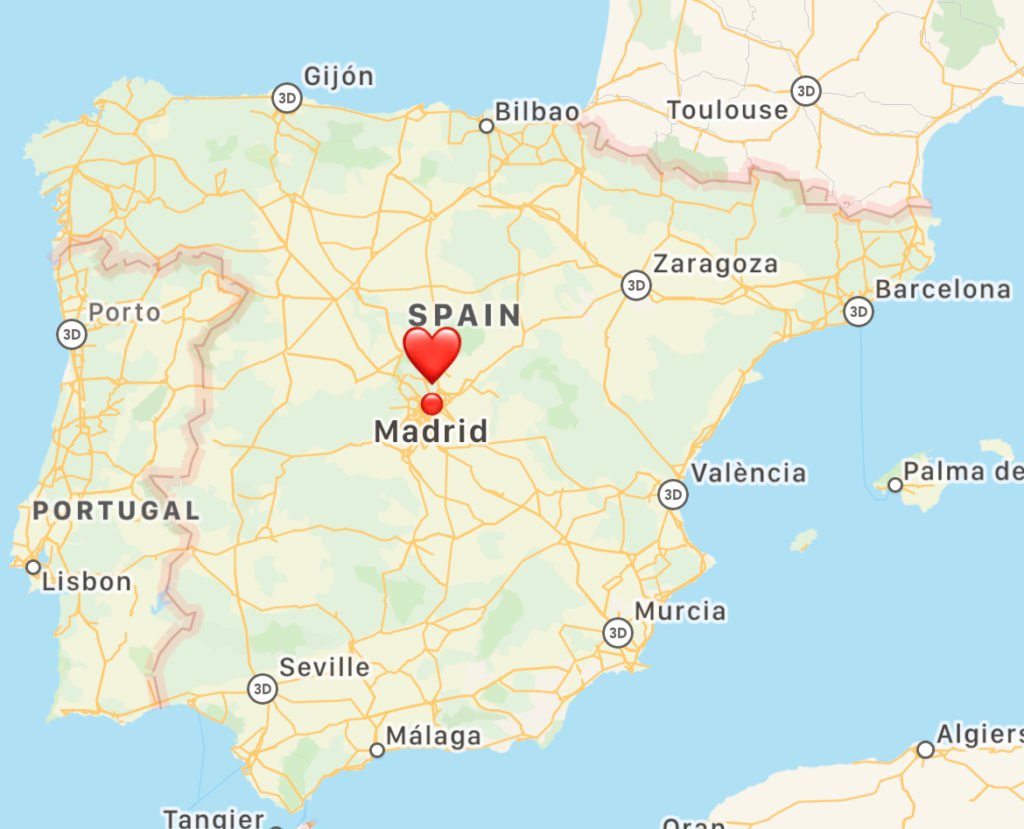
Madrid is located in the center of Spain, in the autonomous community of Madrid. At an elevation of roughly 650 meters above sea level, it is also one of the highest capital cities in Europe.
Its central location is one of the biggest reasons Madrid is such an important transportation hub. From the capital, high-speed rail lines extend in multiple directions across Spain, connecting Madrid with major cities including Barcelona, Valencia, Alicante, Málaga, Córdoba, Seville, Zaragoza, and Valladolid.
Madrid is also well positioned for traveling internationally by land. Spain’s rail and bus networks connect the capital with Portugal and France, while long-distance coach services provide connections to destinations throughout Europe.
🤔 How Do I Travel to Madrid, Spain?
Since Madrid is centrally located, it can be reached in a number of ways, both domestically and internationally.
Here are the main ways to get to Madrid:

Entry Requirements for Spain
If you’re coming from another country, you’ll have to consider the entry requirements for Spain before you travel to Madrid. Here’s what you need to know, so that you don’t accidentally find yourself in trouble.
📄 What Documents Do I Need to Travel to Madrid?
Travelers entering Spain generally need a valid passport or other accepted travel document. Spain is part of the EU and Schengen Zone, which means that you need to be aware of those requirements specifically.

Upgrade Your Inspo
Get the best travel tips, tricks, and hidden gems sent directly to your inbox. You’ll become a better traveler, week after week.
Upgrade Your Inspo
Get the best travel tips, tricks, and hidden gems sent directly to your inbox. You’ll become a better traveler, week after week.
🛂 Visa Requirements for Spain
There are many nationalities that can enter Spain visa-free. Travelers from the EU, Switzerland, Norway, Liechtenstein, and Iceland can all enter without any restrictions at all, while others that don’t need a Schengen visa can visit for up to 90 days within a 180 day period.
⭐️ The 90/180 Rule
It’s important to note that these 90 days are for all countries in the Schengen area. For example, if you spend 10 days in Italy (which is also part of the EU), you will then only be able to spend a total of 80 days in Spain within that 180 day period.
We use the Schengen visa calculator, which is extremely helpful for those that are planning on traveling in and out of the EU for a long period of time.
🇪🇺 Schengen Visas
For those of you that plan on staying longer, or for those of you who are from a country that doesn’t get visa-free access, you will need to in fact apply for a Schengen Visa. Make sure to check the list of countries that need to get a Schengen Visa before traveling.

Comparing Options to Travel to Madrid
There are quite a few ways to travel to Madrid, and having lived there for a few years, I’ve pretty much traveled there in ever way possible.
Ready to learn how to get to Madrid? From flight routes and car rentals to carpooling and buses, we’re covering it all.
❣️ What Airport Do You Fly Into for Madrid?
Madrid’s main airport is Adolfo Suárez Madrid-Barajas Airport (MAD). It is the primary international gateway to the Spanish capital and is located roughly 30-40 minutes from central Madrid by public transportation.
The airport has four passenger terminals and serves a huge number of domestic, European, and international destinations. For travelers coming from outside Europe, flying into Madrid is generally the simplest way to begin a trip around Spain.
One thing we really like about Madrid as an arrival point is that you don’t have to deal with a long journey into the city after landing, and there are options for every budget. The airport is connected to Madrid by Metro, Cercanías commuter rail, buses, taxis, and other private transportation options.
🇪🇸 Domestic Flights into Madrid
Domestic cities that fly direct to Madrid include Almeria, Alicante, Asturias, Badajoz, Barcelona, Bilbao, Bogota, Castellon de la Plan, Fuerteventura, Granada, Gran Canaria, Ibiza, Jerez, La Coruna, Lanzarote, Malaga, Palma de Mallorca, Pamplona, San Sebastian, Santander, Santiago de Compostela, Sevilla, Tenerife, Valencia, and Vigo.
🌎 International Flights Into Madrid
Flights that go from other European cities include Amsterdam, Athens, Balice, Bari, Berlin, Berne, Blagnac, Bologna, Bordeaux, Bristol, Brussels, Bucharest, Budapest, Copenhagen, Dublin, Dusseldorf, Florence, Frankfurt, Geneva, Hamburg, Leipzig, Linz, Lisbon, London, Luqa, Lyon, Manchester, Manises, Marseille, Milan, Munich, Nantes, Naples, Nice, Nowy Dwor Mazowiecki, Paris, Pisa, Prague, Porto, Rome, Sofia, Someseni, Stockholm, Strasbourg, Tirana, Turin, Vantaa, Venice, Vienna, Warsaw, and Zurich.
Cities from the Middle East and Africa that go direct to Madrid include Beirut, Cairo, Casablanca, Dakar, Doha, Dubai, Hassi Messaoud, Jeddah, Luanda, Malabo, Marrakech, Rabat, Tangier, and Tel Aviv. In addition, Shanghai flies there.
Cities that fly to Madrid from the Americas include Bogota, Boston, Buenos Aires, Cali, Cartagena, Comayagua, Dallas, Guayaquil, Havana, Lima, Los Angeles, Mexico City, Miami, Montevideo, Newark, New York, Panama City, Philadelphia, Punta Cana, Punta Caucedo, Rio de Janeiro, Salvador, San Jose, San Pedro Sula, San Salvador, Santa Cruz, Santiago, Sao Paulo, and St Johns.

The 3 Easiest Hacks for Booking Flights that Can Save Your Hundreds
Booking airfare is one of the first steps to booking your trip – and while it can be overwhelming, we’re here to help you!
🛬 How to Travel to Madrid City from the Airport
The international airport is located about 40 minutes away from the city center. You can reach the city easily by both public and private transportation.
Here are the different ways to get from Madrid Airport to the city:
💡 Tickets for the metro and Renfe can be purchased at the machine by using debit card or cash.
🚗 How to Get to Madrid by Car
If you’re looking to travel to Madrid, but also to other surrounding cities, then renting a car can be a great option for your trip. Rental cars are available all over the country, with the biggest amount of availability in well-known cities such as Valencia, Barcelona, and Sevilla.
Driving is pretty easy in Spain, although inside cities it can be less efficient in terms of traffic and parking. We recommend parking outside of the city center, and using public transportation to get around the heart of Madrid.



🚌 How to Travel to Madrid by Bus
Long-distance buses are another option for traveling to Madrid, particularly if you are looking for a cheaper alternative to high-speed trains.
Madrid has major coach stations including Méndez Álvaro and Avenida de América, with bus services connecting the capital with destinations throughout Spain.
Some of the most popular domestic routes to travel to Madrid include:
Some of the international bus routes you can look into include:
🇵🇹 Lisbon → Madrid: 6 1/2 – 7 hours – $15
🇵🇹 Porto → Madrid: 6 1/2 – 8 hours – $33
🇦🇩 Andorra → Madrid: 7 – 8 hours – $30
🇫🇷 Toulouse → Madrid: 9 1/2 hours – $37
🚌 Travel to Madrid by Train
Here are some of the most popular domestic train routes to Madrid:
Here are some popular international train connections:
🇵🇹 Lisbon → Madrid: 13 1/2 – 20 hours – $73
🇵🇹 Porto → Madrid: 8 1/2 – $123
🇦🇩 Andorra → Madrid: 7 – 6 hours – $30
🇫🇷 Narbonne → Madrid: 6 hours – $110


🚙 Using BlaBlaCar to Travel to Madrid
BlaBlaCar is another option for getting to Madrid, particularly if you are traveling on a budget or looking for a more social way to move around Spain. It’s honestly. oneof my favorite options!
The platform connects drivers already traveling between cities with passengers looking for a ride along the same route. Availability depends heavily on the date and destination, so it is worth checking the app when you know your travel dates. It’s particularly helpful if you’re looking within the week, as there are a lot of last minute trips posted.
Madrid’s central location means there are frequently rides connecting it with cities throughout Spain and, depending on the route and date, other European destinations as well
This can be a great way to save money, especially when train prices are higher closer to your departure date.
🚐 Traveling to Madrid with a Group Trip
Group trips are another easy way to travel to Madrid, especially if you are visiting Spain for the first time or want someone else to handle the transportation and itinerary.
Many multi-day tours around Spain include Madrid as either a starting point, ending point, or major stop. Depending on the itinerary, transportation may be handled by private coach, minibus, train, or a combination of different methods.
This can be particularly convenient if you want to visit several Spanish cities without having to organize every train, hotel, and transfer yourself. It’s also fun if you are traveling solo and want to meet other travelers! Many multi-day tours start in Madrid, but you can still find some from Portugal or other areas of Spain.



How to Travel to Madrid: Final Tips & What’s Next
Now that you know how to get to Madrid, you can choose the transportation option that makes the most sense for your trip, whether you are flying in from another continent, taking the train from somewhere else in Spain, road tripping through Europe, or arriving from another European country.
Madrid is one of Spain’s best-connected cities, so getting there is generally pretty straightforward. Once you arrive, the city’s extensive public transportation network also makes it easy to get around without needing a car.
Here are a few final tips to keep in mind when planning how to travel to Madrid:
✈️ Compare all options. Sometimes flights are the most affordable, but you’ll have to account for luggage. Sometimes buses may feel cheapest, but trains end up being easier or having more affordable options.
🚗 Check your rental car’s border policy. If you’re road tripping from Portugal, Andorra, or France, make sure your rental company allows you to take the car across international borders.
📑 Double check your visa requirements. Spain is in the Schengen Zone, so make sure you don’t overstay your allowed time.
🚌 Book international buses and trains ahead of time when possible. Routes and schedules can vary, especially depending on the season.
Want to save the article for later? Pin it!

👀 What’s Next?
Want to learn more about Spain’s capital and the rest of the country? Don’t miss out on our Complete Madrid Travel Guide, along with a couple dozen other Spain travel guides.
Our Valencia guides:
✈️ How to get to Valencia
🚗 How to get around Valencia
🤩 24 Top things to do in Valencia
🪂 48 Unique Things to Do in Valencia
☔️ 22 Things to Do in Valencia When it Rains
🍴 Valencia food guide
🍅 Experiencing Tomatina festival
🔥 Las Fallas Festival
📖 Valencia travel guide
Here are our Canary Islands guides:
🌊 El Hierro Travel Guide
🌋 La Palma Travel Guide
🌳 La Gomera Travel Guide
🌄 Gran Canaria Travel Guide
🏖 Fuerteventura Travel Guide
🏝 Isla de Lobos Travel Guide
🍷 Lanzarote Travel Guide
🤩 50 Epic Spots in Lanzarote
⛴ La Graciosa Travel Guide
🌅 Tenerife Travel Guide
📖 The Ultimate Canary Islands Travel Guide
Here are the rest of our Spain guides:
💃🏻 Celebrating Feria de Abril in Sevilla
☀️ Things to Do in Sevilla
📖 Granada Travel Guide
📸 Most Instagrammable Spots in Barcelona
📖 Barcelona Travel Guide
🌊 Places to Visit in Costa Blanca


So are you ready explore one of the most famous cities in Europe? We hope this guide has helped you plan your visit the Madrid. Have questions? Feel free to drop them in the comments below!
Want to learn more about Madrid or other Spanish cities? Don’t miss out on our other Spain travel guides, and make sure to subscribe to our newsletter to stay up to date with our newest articles.
Ready to start planning an epic trip to Madrid? Well, we’re here to help! Scratch Your Mapa offers custom travel planning services, that we’ve designed to make you the perfect itinerary and save you money along the way. Want to learn more? Take a look at our travel planning packages, or set up your consultation today!

Here are some other articles you’ll love: